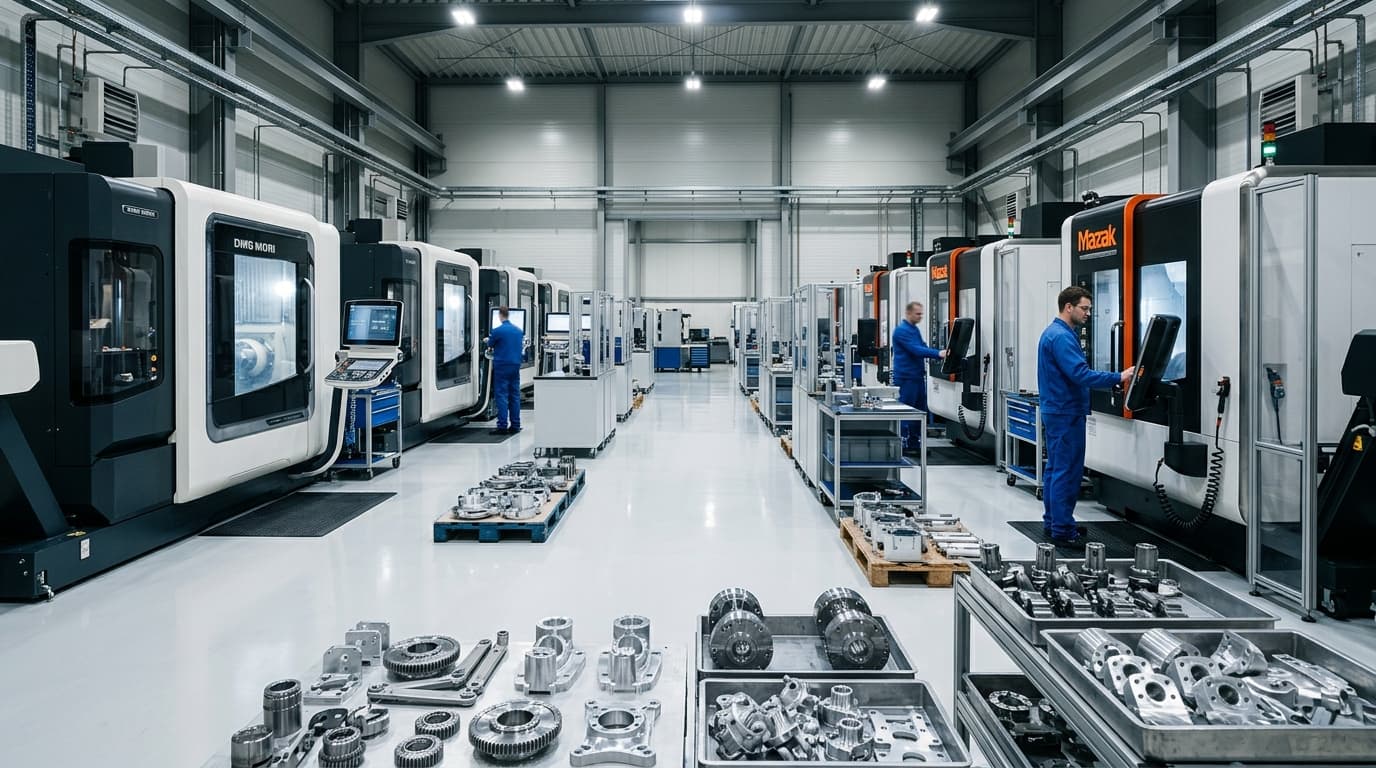
The Hidden Costs in Custom Robot Servo OEM Manufacturing
A transparent breakdown of tooling, NRE, PCBA, and supply chain costs when scaling custom robotic joints from prototype to mass production.
Executive Summary (TL;DR)
- Optimizing solely for BOM cost masks severe Non-Recurring Engineering (NRE) risks; buyers must evaluate the total cost of prototype validation and tooling.
- Custom servo PCBA tooling, firmware integration, and environmental testing often represent the bulk of hidden costs before mass production.
- A transparent 12-gate execution framework prevents supplier lock-in and defines clear FAT (Factory Acceptance Test) ownership.
Moving Beyond the "Per Unit" Price Tag
When hardware teams evaluate custom robot servos, the most common first question is: "What is the unit price for 1,000 pieces?"
While the mass production unit price matters, optimizing solely for the cheapest BOM often masks severe financial risks downstream. The journey from a napkin sketch to 1,000 reliable, field-tested robotic actuators contains several layers of Non-Recurring Engineering (NRE) and tooling costs. Understanding these hidden costs allows procurement teams to budget accurately and avoid supplier lock-in traps.
If you are navigating the quoting process, be sure to read our Custom Robot Servo RFQ Guide to understand the specifications you must provide to suppliers.
Detailed Cost Categories
A true OEM partnership relies on financial transparency. When analyzing a supplier's quote, ensure they break down costs into the following explicit categories rather than baking them indiscriminately into unit prices.
| Cost Category | Key Line Items | Realistic USD Range | What to Check |
|---|---|---|---|
| Tooling | Lamination progressive dies, Housing injection/die-casting molds, PCBA stencils, SMT pallets | $8,000 - $35,000 | Is tooling owned by you? What is the guaranteed shot life of the molds? |
| NRE (Non-Recurring Engineering) | Motor electromagnetic design, Custom PCB layout (HDI), Firmware customization, Thermal simulations | $10,000 - $45,000 | Does this include multiple design spins? Who owns the source code and Altium files? |
| Validation & Compliance | Dyno load testing, Thermal cycling (-40°C to +85°C), Vibration (MIL-STD), EMC testing (FCC/CE), Accelerated Life Testing (ALT) | $15,000 - $60,000 | Are 3rd-party lab reports provided? Learn more about the physics involved in our Thermal Derating Physics Guide. |
| Production Fixturing | Custom assembly jigs, EOL (End-of-Line) calibration stations, automated torque test rigs | $5,000 - $25,000 | Will the EOL data be exported to your cloud infrastructure? |
The 12-Gate Execution Framework
To structure the complex process of custom robot servo engineering, we recommend adhering to a strict gate-driven methodology. This prevents "scope creep" and ensures validation occurs before massive capital is deployed on hard tooling. See our deep dive on the 12-Gate Prototype to Mass Production Execution.
| Gate | Deliverable | Typical Duration | Cost Range (USD) | Owner |
|---|---|---|---|---|
| G1: PRD Sign-off | Final Product Requirements Document, Envelope CAD | 2-4 Weeks | $0 (Pre-sales) | Joint |
| G2: Architecture | Thermal sim, Electromagnetic FEA, PCBA block diagram | 2-3 Weeks | $3k - $8k | OEM |
| G3: EVT Build | Engineering Verification Test (soft tooling, 5-15 units) | 6-8 Weeks | $10k - $25k | OEM |
| G4: EVT Review | Lab testing, basic dyno validation, major bugs identified | 2-3 Weeks | $5k - $10k | Joint |
| G5: DVT Design | DFM updates, hard tooling kick-off | 3-4 Weeks | $15k - $40k (Tooling) | OEM |
| G6: DVT Build | Design Verification Test (hard tooling, 30-50 units) | 8-12 Weeks | $15k - $30k | OEM |
| G7: DVT Validation | Environmental, life testing, EMC compliance | 4-6 Weeks | $10k - $30k | OEM / 3rd Party |
| G8: PVT Build | Production Verification Test (assembly line run, 100+ units) | 4-6 Weeks | Unit BOM Cost | OEM |
| G9: PVT Review | Yield rate analysis, EOL test station validation | 2-3 Weeks | $5k - $10k | Joint |
| G10: MP Release | Mass Production documentation lockdown | 1-2 Weeks | $0 | Joint |
| G11: FAT / Outbound | Factory Acceptance Testing per batch | Ongoing | Baked in BOM | OEM |
| G12: Sustaining | Cost-downs, yield improvements, RMA analysis | Ongoing | N/A | OEM |
Amortization: Volume vs. Unit Price
A major factor in the business case for a custom servo is how NRE and tooling costs are amortized over production volumes.
Supplier Lock-in Red Flags
Opaque suppliers often use a "Razor and Blades" model: they subsidize upfront development costs to lock you into a proprietary architecture, ultimately holding your supply chain hostage when you attempt to scale.
| Red Flag | Why It's Dangerous | What to Negotiate |
|---|---|---|
| "Free" Hard Tooling | The supplier technically owns the molds and dies. If they raise unit prices by 30% next year, you cannot move production without paying for entirely new tooling. | Contractually specify that all tooling paid for (directly or via amortization) is the property of the buyer and physically transferable. |
| Proprietary Firmware/Comms | If the servo uses a non-standard communication protocol or encrypted drive firmware, integrating a second-source supplier becomes an impossible software rewrite. | Demand standard protocols (CANopen/CiA402, EtherCAT) and open-source or fully documented registers. |
| Custom Mating Connectors | Designing in a proprietary connector means you must buy expensive, single-source wire harnesses. | Insist on industry-standard connectors (e.g., JST, Molex, TE Connectivity) for all interfaces. |
| No Access to EOL Data | Without seeing the End-of-Line test data, you cannot verify if field failures are due to poor supplier QA or your own robot's application stress. | Require API access or CSV exports of FAT (Factory Acceptance Test) results per serial number. |
Hidden Cost Scenario Analysis
Let’s analyze three scenarios for a 2,000-unit custom actuator deployment over 2 years.
Scenario A: The Cheap Unit Price (Opaque Supplier)
- Upfront Quote: $0 NRE, $0 Tooling, $350 Unit Price.
- Reality: EVT/DVT testing is skipped. The motor overheats in the field due to poor thermal dissipation.
- Hidden Costs: $150k in RMA replacements, $80k software team time trying to write custom firmware workarounds, $50k in delayed time-to-market.
- 2-Year TCO: $980,000 (and massive reputational damage).
Scenario B: The Over-Engineered Approach (In-House Design)
- Upfront Quote: $250k internal R&D, $80k hard tooling.
- Reality: Your robotics startup spends 14 months trying to build a motor controller from scratch instead of focusing on high-level robot kinematics.
- Hidden Costs: Opportunity cost of engineering time, 3 failed PCB respins ($45k). Unit cost ends up at $450 because you lack purchasing power.
- 2-Year TCO: $1,275,000.
Scenario C: The Transparent OEM (CustomRobotServo Approach)
- Upfront Quote: $45k NRE/Validation, $25k Tooling (fully owned by you), $380 Unit Price.
- Reality: Detailed DVT testing catches a thermal issue early. The housing is slightly modified before mass production.
- Hidden Costs: $0. Highly predictable scaling.
- 2-Year TCO: $830,000.
IP and Tooling Ownership Checklist
Before issuing a PO for a custom servo project, ensure you have contractual clarity on the following items. Do not let these remain ambiguous.
- Mechanical CAD: Native parametric files (STEP/IGES at minimum, SolidWorks/NX preferred).
- PCBA Files: Altium/KiCad source files, Gerbers, BOM, and pick-and-place data.
- Tooling Rights: Explicit clause stating that all lamination dies, injection molds, and SMT stencils are the physical property of the buyer.
- Firmware Configuration: Access to tuning software, PID loop gains, and commutation angles.
- Validation Reports: Full PDF reports of EMI/EMC scans, thermal chamber logs, and dyno torque-speed curves.
By treating a custom servo engagement as an engineering partnership rather than a transactional component purchase, hardware teams can aggressively drive down TCO while securing their supply chain.
Inquiry Email
Include drawings, torque/speed, protocol, and prototype quantity.
Author

Categories
More Posts
The Physics of Thermal Derating in Robot Servos: Beyond the Datasheet
Why datasheet peak torque is a trap, and how thermal derating, motor constants (Km), thermal resistance (Rth), and potting define real robot performance.
Unboxing the Backlash Blackbox: Harmonic vs Cycloidal vs Planetary for Robotic Joints
A deep engineering guide to choosing between Harmonic, Cycloidal, and Planetary reducers for custom robotic joints to manage backlash, rigidity, and shock loads.
EtherCAT vs CANopen for Multi-Axis Robotic Actuation
Analyzing the real-world latency, synchronization, and cost trade-offs of EtherCAT versus CANopen in custom multi-axis servo drives.